Ask Specific Accessibility Questions Before a Weekend Trip
Accessible can mean different things in a short listing. Turn your own requirements into concrete questions about the full journey, accommodation and activities, then keep the confirmed answers with the trip plan.
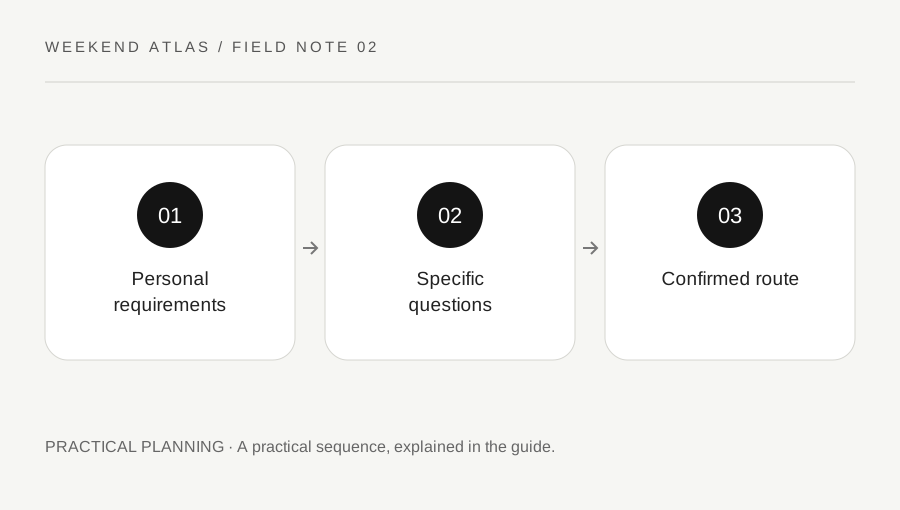
Original explanatory diagram. Examples illustrate a method or decision; they are not claims of personal testing.
Describe requirements in practical terms
Start with what you need to use a place comfortably: a step-free entrance, a particular doorway width, a quiet waiting space, captions, an accessible toilet or another relevant detail. You do not need to share a diagnosis to ask a specific operational question. Keep preferences and essential requirements separate so the enquiry is easy to answer.
For an illustrative traveller using a mobility device, ground-floor room is not enough information if the building entrance has steps or the bathroom arrangement is unsuitable. Record the relevant dimensions or features you need confirmed. Avoid accepting a broad yes without understanding which part of the requirement the provider has actually checked.
Check the whole chain of the visit
Map the journey from arrival point to accommodation, activity and return. A venue can have an appropriate entrance while the suggested route from the station includes stairs. Check transfers, surfaces, gradients, toilets and places to rest where they matter to you. Do not assume an accessible destination makes the whole trip accessible.
Use official transport and venue guides for the actual locations. VisitEngland points travellers toward detailed access resources, while individual providers can answer questions about their current facilities. Reviews can add useful experience, but distinguish their date and circumstances from a current provider confirmation. Keep unresolved links visible rather than treating them as minor details.
Ask questions a provider can verify
Refer to a named entrance, room category or service and ask for measurable or descriptive information. Can the lift reach the floor of the booked room? Is the accessible toilet open during the planned visit? What is the route when the usual entrance closes? A request for a current photograph or access guide may help where a verbal description is unclear.
Explain the intended date and time because facilities and staffing can vary. If a service needs advance arrangement, ask about the process and confirmation. Do not assume a listed facility is reserved for you. Record who replied and what remains conditional without turning an ordinary email into a guarantee beyond what the provider’s actually said.
Build a suitable alternative for one weak link
Identify the part of the plan with the most uncertainty and find an appropriate fallback. That might be another entrance, a shorter activity or a different transport leg. The fallback should meet the essential requirement rather than simply be nearby. Ask the traveller whose needs are involved whether the alternative is acceptable.
For an illustrative museum visit, a planned lift outage might make one gallery unavailable while other areas remain usable. Decide in advance whether that still makes the visit worthwhile. Do not describe a workaround requiring unwanted assistance as equivalent to independent access. Preserve the person’s choices and avoid making assumptions about what they can manage.
Reconfirm consequential details close to travel
Check for service changes, closures or maintenance that affect the confirmed route. Keep the relevant contact details and access information available offline, with personal information shared only with appropriate travel companions. If something changes, ask about the actual effect rather than relying on the original broad description.
After the trip, record useful specifics and the date for your own future planning. Do not turn one visit into a permanent claim that a place is suitable for everyone. Requirements and facilities vary. A good accessibility enquiry produces an informed choice for a particular traveller and trip, with clear evidence and remaining limits.
A practical checklist
Choices are saved in this browser. Reset them here or clear this site’s browser storage.
Questions that come up
Is an accessible label enough?
Use it as a starting point, then confirm the features relevant to your own requirements.
Must I disclose a diagnosis?
Specific functional requirements are often enough for planning questions. Share personal information only as appropriate to the service you request.
Can reviews replace a provider enquiry?
They can add context, but dates and circumstances vary. Confirm consequential current details with the appropriate provider.
References & scope
Background references checked on 18 October 2026. Worked examples and diagrams are original teaching material.