Plan a First Nature Reserve Visit Around Paths, Facilities and Wildlife
A nature reserve can offer a rewarding short outing without a distant journey. Check the site-specific route and facilities, choose a modest observation plan and let wildlife remain unpredictable rather than treating a sighting as an attraction guarantee.
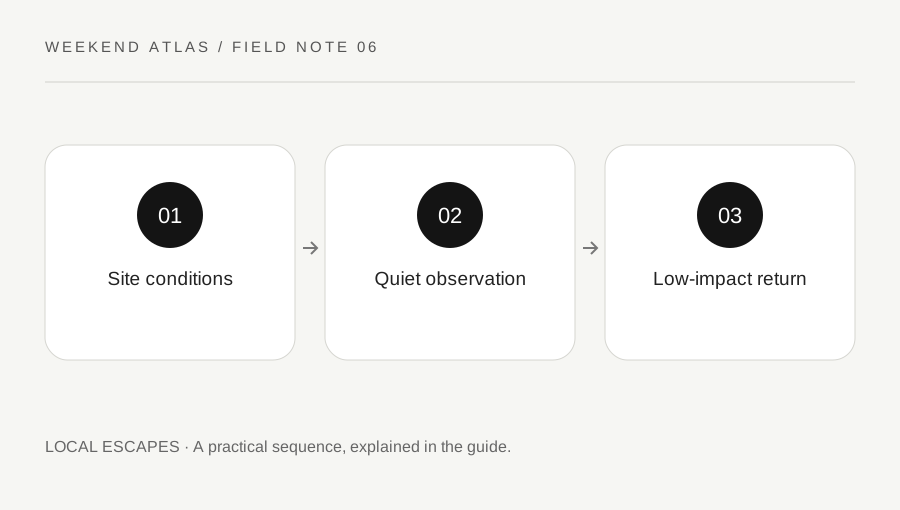
Original explanatory diagram. Examples illustrate a method or decision; they are not claims of personal testing.
Choose the actual reserve and entry point
Use the land manager’s official page to confirm access, opening arrangements, parking or public transport and any seasonal closure. A reserve can have several entrances with different facilities. Check where the suggested trail begins rather than following a general map pin to the nearest boundary. Do not assume a visitor centre is present.
For an illustrative short outing, a reserve with a clearly described loop and a known rest point may fit better than a larger site with an uncertain approach. Read current notices before travelling. The RSPB publishes individual reserve information, and those site details are more useful than assuming all reserves share the same paths or services.
Read path and facility descriptions
Check surface, slope, distance, gates, seating and toilet availability against the group requirements. A path described as natural may become muddy after rain. A short route can still have a steep section or difficult surface. Contact the manager if a consequential detail is unclear and keep the answer with the plan.
Pack according to the confirmed facilities. Bring suitable drinking water and any ordinary food needed rather than assuming a café exists. In an illustrative comparison, a longer reserve route with toilets and seating may suit one visitor better than a shorter exposed path with neither. Avoid reducing suitability to distance alone.
Set a small observation goal
Choose a simple focus such as noticing habitat changes, watching from one hide or learning to distinguish a few common shapes. You do not need expensive equipment or a promise of rare wildlife for the visit to be worthwhile. Use official seasonal information as context, not as a guarantee of what will appear during your hour there.
Allow quiet time instead of walking continuously from one possible sighting to another. If you bring binoculars or a camera, practise basic controls before the visit so the equipment does not dominate the outing. Keep enough awareness of paths and other visitors while looking through a lens. A missed photograph is not a reason to approach an animal more closely.
Follow the reserve specific behaviour rules
Stay on permitted routes and follow signs protecting sensitive areas. Check the exact policy for dogs, cycles, drones, photography and food where relevant. Rules differ by site and sometimes by season. RSPB facility pages illustrate that even dog access can be limited to particular circuits rather than the whole reserve.
Keep noise low around observation areas and give other visitors room. Do not feed wildlife or use an action that disturbs it merely to improve a view. Take litter away through the appropriate arrangement and leave natural objects where they belong. If a path is closed, choose another permitted route rather than assuming a brief detour has no effect.
Keep a return margin and a useful record
Know the exit route and any gate or car-park closing time. Check the return transport rather than relying on a daytime service assumption. If weather changes or the group needs a shorter visit, use the planned way back. A local outing can be satisfying without completing every path or waiting indefinitely for a particular species.
Afterwards, record the route, conditions and one observation you enjoyed. Keep uncertain species identifications tentative and use an appropriate reference later. Recheck current access before another visit. The value of a first reserve trip is learning how the place works and how to observe it respectfully, not compiling a guaranteed list of wildlife encounters.
A practical checklist
Choices are saved in this browser. Reset them here or clear this site’s browser storage.
Questions that come up
Will the advertised wildlife always be visible?
No. Seasonal information describes possibilities, not a guaranteed sighting on a particular visit.
Are dogs allowed throughout every reserve?
No. Check the specific site and seasonal rules, including permitted routes.
Is a short path always accessible?
No. Surface, gradient, gates and current conditions can matter as much as distance.
References & scope
Background references checked on 18 October 2026. Worked examples and diagrams are original teaching material.